I don’t generally consider myself someone who likes to set goals. But I’m surprised to find that I really like setting goals for what to observe with my telescope this month.
The thing is, my eight-inch Dobsonian telescope weighs about 70 pounds, too heavy for me to lift on my own, so I can’t observe on Thursday, because Thursday is Mitch’s Magic The Gathering (MTG) night. And it can’t be Monday either, which is pickleball night for both of us. Wednesday and Friday are Taichi nights. So normally I only have Tuesday nights and weekends. Now take out the nights that are cloudy or too cold to stand outside, and each observation night becomes precious. I have to plan ahead so I know what to observe when those nights come.
In short, my goal for April is to observe Uranus, M81, and M82.
April 23 — Uranus + Venus #
April 23rd falls on a Thursday. So I’ll have to ask Mitch to help me before he leaves the house, because this might be my one rare chance to observe Uranus through an 8-inch telescope. So far I’ve observed the other planets in our solar system but not Uranus or Neptune. The biggest challenge is that they’re so far away and appear so dim that it’s not easy to locate them in the eyepiece when you’re star-hopping manually with a Dobsonian mount. That’s why I’m so excited about April 23rd: Uranus is going to be very close to Venus in the sky, with the Pleiades nearby. Venus is unmistakable, so it can act like a signpost pointing me right to Uranus. I think I have a real chance of spotting it this time.
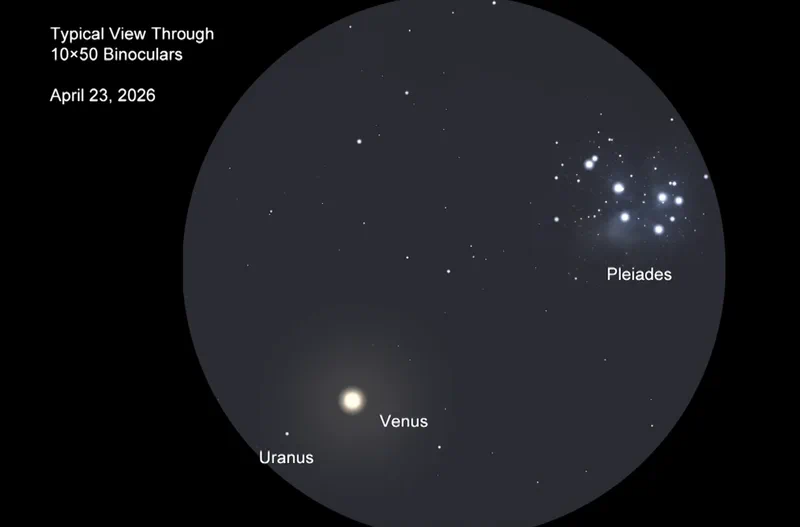
I’m also keeping my expectations in check. Uranus is going to be tiny in the view. Even Jupiter, where I can see the orange and white cloud bands, and Saturn, where I can see the rings — they look much smaller through the eyepiece than you’d expect if you’re used to those beautiful NASA or James Webb photos. But just finding it and knowing I’m looking at a planet nearly 1.6 billion miles away — that’s the thrill.
Uranus is also just a strange, wonderful planet. It rolls on its side as it orbits the Sun, with its axis tipped almost 98 degrees, so each pole gets 42 Earth years of continuous daylight followed by 42 years of night. Its upper atmosphere smells like rotten eggs — hydrogen sulfide. The only human-made probe that has ever visited Uranus is Voyager 2, which flew by on January 24, 1986.
Spring Galaxy Season — M81 and M82 #
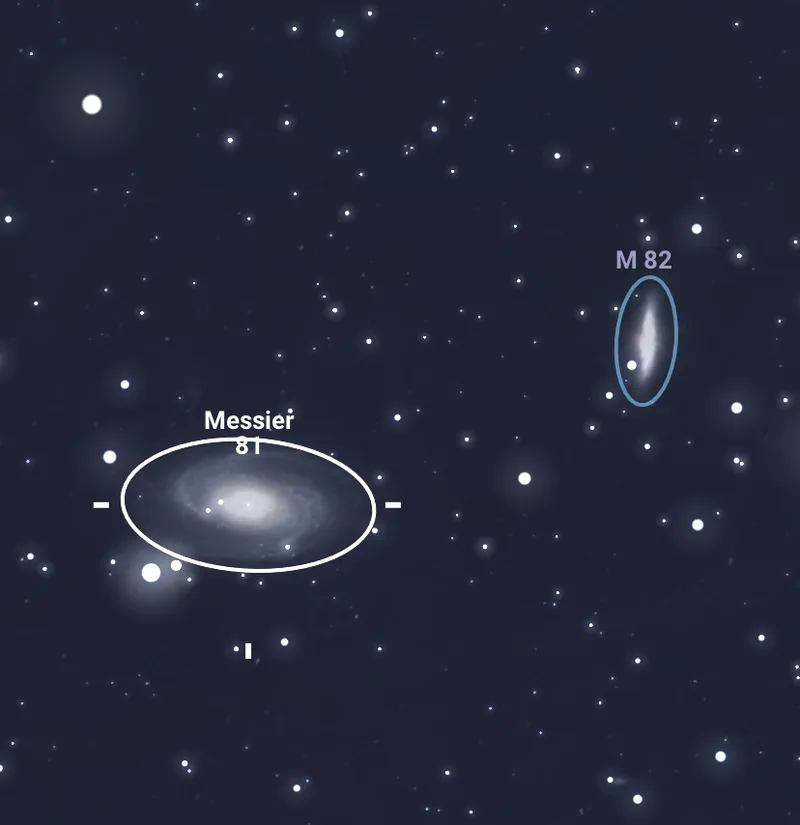
The other thing I really want to observe this April is galaxies. Spring is galaxy season — the Milky Way’s plane dips below the horizon in the evening, opening up a window to peer deep into intergalactic space. At the top of my list are M81 (Bode’s Galaxy) and M82 (the Cigar Galaxy), a stunning pair in Ursa Major that fit in the same eyepiece field of view.
M81 is a grand-design spiral, a bit like our own Milky Way, with beautiful arms winding around a bright core. M82, right next to it, looks completely different: a starburst galaxy seen nearly edge-on, forming new stars at roughly ten times the rate of our own Milky Way. The two are gravitationally entangled. Both galaxies sit about 12 million light-years away — which means the light hitting my eyepiece in April left them back when some of our ape ancestors were first experimenting with walking upright.
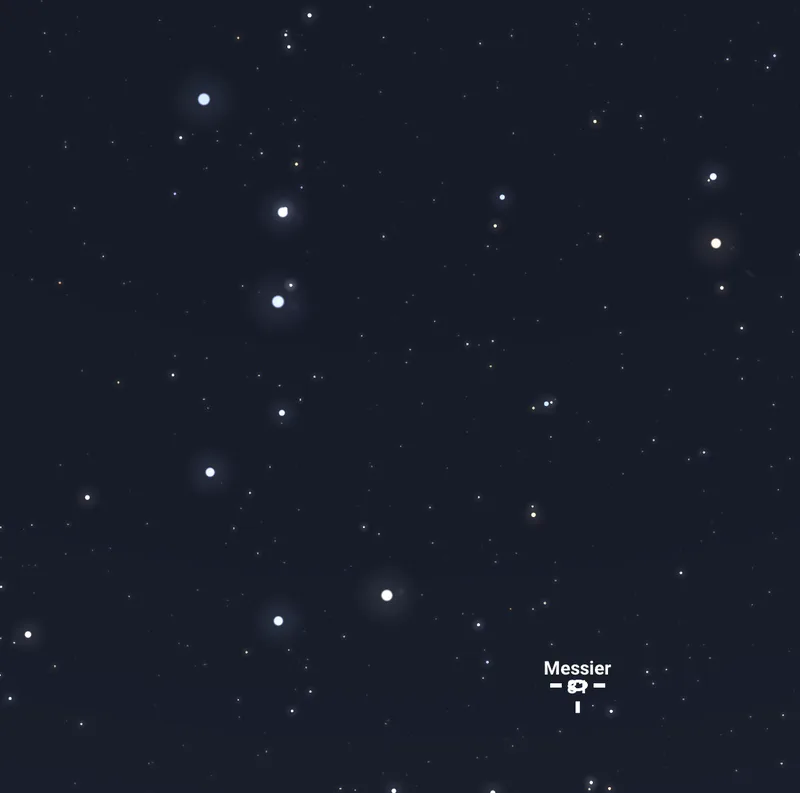
How to find them? Follow the Big Dipper!
- Draw a diagonal line across the bowl, from one corner to the opposite corner
- Extend that line about the same distance beyond the bowl
🔭✨ Wish me luck and clear skies! 🌌