I have a confession: for the longest time, I was not a fan of camping.
I never understood why people wanted to bring so much of home into a remote place: cooking gear, raw food to cook over a campfire, a heavy bundle of firewood, a tent to assemble, and an inflatable mattress that somehow always felt slippery and left my back and neck aching.
The one thing that mesmerized me was the fire. While everyone else sang and chatted, I could sit for a long time, entranced by the dancing flames. But that alone was never enough to ignite my interest in camping.
That changed a few years ago, when we brought a telescope.
Not a small telescope—an 8-inch Dobsonian, over a meter tall and weighing more than 70 pounds. Thanks to my astronomy patron, my forever supporter of whatever subject I decide to pursue, my husband managed to bring it with us to Sugarloaf Ridge State Park.
For the first time, I looked forward to camping. I started enthusiastically planning what I wanted to observe.
Before then, I had treated camping as a way to calibrate the comforts of daily life. I forgot where I first heard the idea, but I agree with it: to stay happy, you need to manually engineer peaks and valleys. When you live comfortably every day, comfort slowly loses its charm. But after camping, you come home with renewed gratitude for a hot shower, hand soap and comfortable bed. Once a year, I used camping as a small stoic exercise in appreciation.
But once stargazing became an after-dinner activity by the campfire, it changed everything.
I started caring which direction a campsite faced: north or south? I remind myself to prepare a list of celestial objects visible from either direction, so I have options. I try to make progress on my Messier challenge, checking which deep-sky objects will be visible that month. And if we cannot bring the telescope, I check which nebulae and star clusters make good targets for our 8×40 binoculars.
Last weekend, we went to China Camp State Park with five friends. I brought binoculars and a green laser pointer—a small device that sends a visible green beam into the sky, making it easy to point out stars.
After dinner, when the sky had grown dark, I noticed that our campsite faced north. So I began with my first target: the Andromeda Galaxy.
Many people have heard of Andromeda. It is the closest large galaxy to the Milky Way, but not many are aware that it is much larger than our home galaxy—roughly twice as wide, with perhaps a trillion stars, compared with the Milky Way’s 100 to 400 billion.
I showed my friends how to find it.
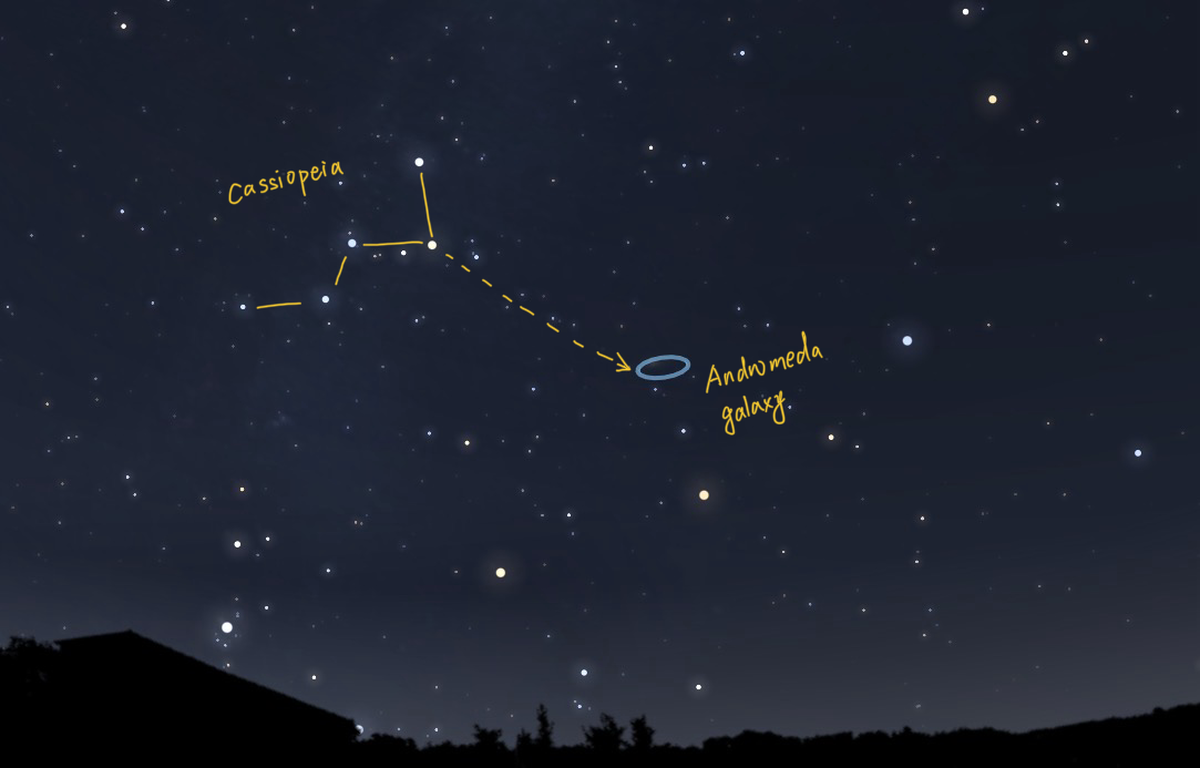
“See that W shape? That’s Cassiopeia. Now find one of the V shapes. Use it as an arrow, and point in this direction.”
In that part of the sky, there is a faint, fuzzy patch. That is the Andromeda Galaxy—one of the most distant objects visible to the naked eye.
Bang.
It never gets old, telling people that fact. It is mind-boggling and soothing at the same time—for the audience and for the person sharing it.
This was my second unofficial astronomy outreach. The first was in our neighborhood; this time, it was for our friends. No one asked me to do it, but I feel a tremendous satisfaction, and almost a compulsion, to share it.
Whenever I do something related to astronomy, it lights my heart and sparks my mind. I have thought about pursuing it academically, or as a profession. But I am afraid that taking it too seriously might extinguish the spark—that the joy could be lost forever.
Maybe this is the right distance. Maybe this is the right avenue.
Maybe.