I’d like to share two quotes. Both have a magical, meditative effect; both make me feel small and expansive at the same time.
Pale Blue Dot #
The first is from Carl Sagan’s book Pale Blue Dot, Chapter 1 - “You Are Here”.
From this distant vantage point, the Earth might not seem of any particular interest.
But for us, it’s different. Consider again that dot. That’s here. That’s home. That’s us.
On it, everyone you love, everyone you know, everyone you ever heard of, every human being who ever was, lived out their lives. The aggregate of our joy and suffering, thousands of confident religions, ideologies, and economic doctrines, every hunter and forager, every hero and coward, every creator and destroyer of civilization, every king and peasant, every young couple in love, every mother and father, hopeful child, inventor and explorer, every teacher of morals, every corrupt politician, every “superstar”, every “supreme leader”, every saint and sinner in the history of our species lived there - on a mote of dust suspended in a sunbeam.
The Earth is a very small stage in a vast cosmic arena. Think of the rivers of blood spilled by all the generals and emperors so that in glory and triumph, they could become the momentary masters of a fraction of a dot.
The first time I encountered this quote was in a UC Berkeley astronomy class. We were learning about the planets in the Solar System, and that class was about planet Earth. The opening slide of that class was this iconic image, taken by Voyager 1 on Feb 14th, 1990 (what a fitting love letter to humanity on Valentine’s Day!).
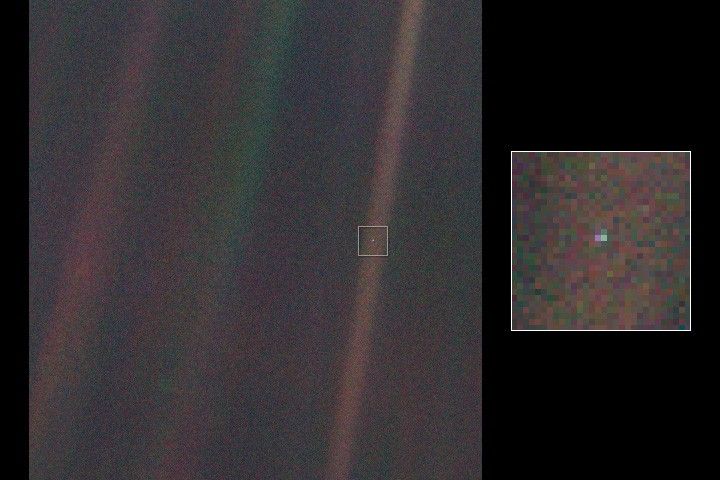
I can’t remember how many times I’ve listened to and read this passage, but I remember feeling moved, touched, and inspired every single time afterwards. Sometimes you go through a new experience and it feels eye-opening; this is one of those that feels soul-cracking, like a beam of light shining upon the cocoon of a soul, and your heart wakes up and bathes in the brightness and warmth. Whenever I feel an existential crisis, or feel troubled, worried, or puzzled about the meaning of life, I find it comforting that our planet is a tiny speck enveloped in cosmic dark, and if the entire Earth is this tiny, it’s impossible not to feel that my problems are trivial beyond trivial. Not just my problems. So are the games of thrones among powerful geopolitical players. After all, from the vantage point of space there are no borderlines at all. How absurd to fight over the boundary of a fraction of a dot, and the personal glory of being its momentary master.
I also get a tint of gratitude. How lucky I am to get to be a form of life on this pale blue dot, the only place we know that harbors life for now, and perhaps forever. The beauty and the ugly, the drama and the intensity, the miracle and the mystery. And I’m part of it.
Time #
The second quote is from Alan Watts, from his discussion on Intelligent Mindlessness. There used to be an audio recording, but now I can only find the text version, at The Library of Consciousness. But an artist named Kazam, who must also have been inspired by Alan Watts, wove this quote into a dreamy track called A Story About Time.
Most people nowadays say, “I have no time.” Of course you don’t. Because you are not aware of the present.
You know, the present is represented on your watch by a hairline that is as thin as possible as it consistent with visibility.
And so everybody thinks the present is [KNOCK] instead of [GONG].
Now, the present is the only real time. There is no past, and there isn’t a future. And there never will be.
I remember the first time I heard and read this, I was so intrigued by the part “There is no past, and there isn’t a future. And there never will be”. What does he mean? Does he mean that the past is just a fabrication of personal memory, with no intrinsic solidity, since it’s open to interpretation and even evolves as your experience changes? Is he trying to teach us about the futility of frantic planning culture, and the narrative that you are the owner of your destiny? Or perhaps it relates to the alien analogy Brian Greene once presented: spacetime is like a loaf of bread, and an alien billions of light-years away, if they move toward us, their slice of “now” might be angled toward our future, even though we can’t see it?
This is the track I’ll put on repeat when I want my mind to wander. It also reminds me to treat the present, the now, properly.
Most of us treat the present like a knock, a tap, gone the instant you notice it. But the present is more like the sound of a singing bowl when you strike it; it doesn’t vanish in an instant. It lingers, and it has room. And the room has space in it, to breathe, to notice, to actually do the thing.
Spacetime #
I didn’t set out to keep these two together, but in retrospect, naming my YouTube channel Wen’s Spacetime was probably influenced by these two quotes too:
- One pulls me far enough out that my troubles come back to their real size — space.
- The other pulls me far enough in that this moment is wide enough to stand in — time.
In fact, space and time aren’t orthogonal to each other. They’re one word, spacetime, the fabric of our universe.